Difference between revisions of "User:Hexanna"
(remove incorrect statement, on 4x4, a4 is winning in reverse hex but not infinite recursive swap) |
(remove more old stuff (answer to the puzzle is l14)) |
||
| Line 24: | Line 24: | ||
*** Knowing how to play across multiple local regions is very hard, and it's often different across games (especially for humans). It's better to master local play first, since similar local play principles will be relevant every game. | *** Knowing how to play across multiple local regions is very hard, and it's often different across games (especially for humans). It's better to master local play first, since similar local play principles will be relevant every game. | ||
* Now some points about how to learn. From what I observe, people often read strategy advice and then fail to follow it consistently. This is often either because of skepticism, or not realizing just how often particular pieces of advice should be followed (it's tempting to think that you've found the exception to the rule). | * Now some points about how to learn. From what I observe, people often read strategy advice and then fail to follow it consistently. This is often either because of skepticism, or not realizing just how often particular pieces of advice should be followed (it's tempting to think that you've found the exception to the rule). | ||
| − | ** It's healthy to be skeptical—there is a lot of ''bad'' strategy advice, and it would probably do more harm than good | + | ** It's healthy to be skeptical—there is a lot of ''bad'' strategy advice, and it would probably do more harm than good to implement every piece of advice you come across. So I'm not expecting readers to take everything in this guide at face value either (and many statements have nuances/exceptions, some of which I don't even realize should be explained to readers; it's hard to translate precise intuitions into words after all). Unfortunately, separating the signal from the noise is hard. If you're skeptical about a principle or how strongly it holds, try running it through KataHex yourself (if you have it installed), and try variations to understand the nuances, when the principle holds, and importantly ''why'' it holds. Sometimes people are skeptical of KataHex itself or think they can do better; I think there are good heuristic reasons why this thinking is misguided (the most simple one is that KataHex is far stronger than the strongest humans). |
* What are the most important principles? Even if you learn nothing else, you should learn these: | * What are the most important principles? Even if you learn nothing else, you should learn these: | ||
*# Avoid playing close to your own edge, especially in the opening, unless you have a very good reason to do so. | *# Avoid playing close to your own edge, especially in the opening, unless you have a very good reason to do so. | ||
| Line 60: | Line 60: | ||
** Most of the time, Red can still play the "premove P, click (*)" strategy from Case 1. However, with a small probability, Red waits for Blue to play at P, then he plays at (+) instead, hoping Blue will premove her ''next'' move. This is a premove ''trick'', and unlike the strategy from Case 1, it's important that Red doesn't play it 100% of the time—he needs to play it as part of a mixed strategy. If Blue notices, the downside is that the ladder has just been pushed up one row. But if Blue premoves and pushes the ladder again at Q, then Red plays at (-) and immediately wins. | ** Most of the time, Red can still play the "premove P, click (*)" strategy from Case 1. However, with a small probability, Red waits for Blue to play at P, then he plays at (+) instead, hoping Blue will premove her ''next'' move. This is a premove ''trick'', and unlike the strategy from Case 1, it's important that Red doesn't play it 100% of the time—he needs to play it as part of a mixed strategy. If Blue notices, the downside is that the ladder has just been pushed up one row. But if Blue premoves and pushes the ladder again at Q, then Red plays at (-) and immediately wins. | ||
** Blue might not like the fact that Red has this premove trick. One possible resource for her is to "premove (*), click Q" while defending the ladder; this probably works quite well in bullet. | ** Blue might not like the fact that Red has this premove trick. One possible resource for her is to "premove (*), click Q" while defending the ladder; this probably works quite well in bullet. | ||
| − | |||
| − | |||
| − | |||
| − | |||
| − | |||
| − | |||
==katahex/general strategy (draft material)== | ==katahex/general strategy (draft material)== | ||
| Line 142: | Line 136: | ||
# It's resistant to partial solutions. Let's say that someone miraculously comes up with a constructive proof that the obtuse corner is winning on 19x19. No problem, players will just stop playing obtuse corner and play other opening moves instead. | # It's resistant to partial solutions. Let's say that someone miraculously comes up with a constructive proof that the obtuse corner is winning on 19x19. No problem, players will just stop playing obtuse corner and play other opening moves instead. | ||
# It's fun to try to trick players into swapping a weak move or not swapping a deceptively strong move. :) | # It's fun to try to trick players into swapping a weak move or not swapping a deceptively strong move. :) | ||
| − | |||
| − | |||
| − | |||
| − | |||
| − | |||
| − | |||
| − | |||
| − | |||
| − | |||
| − | |||
| − | |||
| − | |||
| − | |||
| − | |||
| − | |||
| − | |||
| − | |||
| − | |||
| − | |||
==Insights and tidbits from KataHex (hzy's bot)== | ==Insights and tidbits from KataHex (hzy's bot)== | ||
| Line 315: | Line 290: | ||
* If Red plays a weak stone worth x < 0.5, Blue should play a move worth less than x + 0.5 (or else Red will swap2). If Blue's move is worth y, then Red should play a move as close to (y - x) + 0.5 as possible, so that Blue's swap3 decision is difficult. | * If Red plays a weak stone worth x < 0.5, Blue should play a move worth less than x + 0.5 (or else Red will swap2). If Blue's move is worth y, then Red should play a move as close to (y - x) + 0.5 as possible, so that Blue's swap3 decision is difficult. | ||
* Red should play a weak move that's hard for Blue to find a tricky reply to (where a "tricky" reply is one that makes it hard for Red to equalize, such that Blue has an easy time deciding whether to swap3 or not). | * Red should play a weak move that's hard for Blue to find a tricky reply to (where a "tricky" reply is one that makes it hard for Red to equalize, such that Blue has an easy time deciding whether to swap3 or not). | ||
| − | |||
| − | |||
| − | |||
| − | |||
| − | |||
| − | |||
| − | |||
| − | |||
Revision as of 02:02, 7 November 2025
I started learning Hex mid-July of 2021, about 2 weeks before I created my LittleGolem account.
PlayHex > Settings > Shading pattern > Custom > t = (2*row + 3*col) % 7; (t==0 ? 0 : (3^t % 7))/6
Contents
draft of more strategy stuff
There's a fair amount of stuff for Strategic advice from KataHex that I've either been too lazy to write up / polish, or haven't thought of a good way to explain. I also haven't properly conveyed which things are important; some things come up rarely and should either be mentioned briefly or cut for the article. There's also a tradeoff in generality/specificity and concreteness/abstractness. Also, I didn't realize how long the below (unfinished) section was already until I wrote it.
Big picture, and some meta-points
- This guide assumes you've read Hex: A Strategy Guide or have equivalent knowledge.
- Hex: A Strategy Guide predates KataHex, but it's very well made, and 90% of the advice is still good.
- On smaller boards, tactics and raw calculation matter more. On larger boards, strategy matters more. (It's ultimately a spectrum, and it various by skill level: for beginners, size 13 might be considered large; for strong players, tactics can matter a great deal on size 13.)
- On smaller boards, the exact board size affects strategy (some moves can be good on 11×11 but not 12×12). The larger the board, the less the exact board size matters. The general strategy for 19×19 and 20×20 should be nearly identical.
- On smaller boards, there is more space close to corners and edges. On larger boards, there is more "open" space (hexes not close to corners and edges). I intentionally said "open" space and not "center" space, because there is not much special about hexes near the center of the board, except that they are far away from corners and edges. But on large boards, there are many such areas.
- In particular, the larger the board size (starting at around size 13–15), the more important it is to know how to play in "open" areas. Many existing guides cover corner/edge strategy heavily—and correctly so, as corners/edges remain important up to very large sizes (25–30 or so). People read those guides and often know how to play the first 10–20 moves of a 17×17 game, but often not after that, when most of the game is still remaining!
- Strategy can also be local or global. Local strategy tells you how to play within a small region of the board, and global strategy tells you how to play in relation to the whole board (or across multiple local regions). Both are important.
- The strategy of "open" areas is mostly local, and so the larger the board, the higher the relative importance of local strategy. Why?
- On a large Hex board, the "middle" is relatively homogeneous—two separate open areas near the middle are basically the same in terms of how you should play them; it doesn't matter that one of the areas is 15 hexes away from an edge and the other one 18. Because of this homogeneity, the same basic principles will apply multiple times in the span of a game.
- Knowing how to play across multiple local regions is very hard, and it's often different across games (especially for humans). It's better to master local play first, since similar local play principles will be relevant every game.
- Now some points about how to learn. From what I observe, people often read strategy advice and then fail to follow it consistently. This is often either because of skepticism, or not realizing just how often particular pieces of advice should be followed (it's tempting to think that you've found the exception to the rule).
- It's healthy to be skeptical—there is a lot of bad strategy advice, and it would probably do more harm than good to implement every piece of advice you come across. So I'm not expecting readers to take everything in this guide at face value either (and many statements have nuances/exceptions, some of which I don't even realize should be explained to readers; it's hard to translate precise intuitions into words after all). Unfortunately, separating the signal from the noise is hard. If you're skeptical about a principle or how strongly it holds, try running it through KataHex yourself (if you have it installed), and try variations to understand the nuances, when the principle holds, and importantly why it holds. Sometimes people are skeptical of KataHex itself or think they can do better; I think there are good heuristic reasons why this thinking is misguided (the most simple one is that KataHex is far stronger than the strongest humans).
- What are the most important principles? Even if you learn nothing else, you should learn these:
- Avoid playing close to your own edge, especially in the opening, unless you have a very good reason to do so.
- Think of your own edge as a whole row of stones of your color. You already have a bunch of stones (and thus strength) there, and playing yet another one close by would be a waste. That stone is much better served elsewhere, where you don't have as much strength.
- Bridges are the most efficient way to connect your own stones—not adjacent stones, trapezoids, crescents, or hammocks. If there are no opposing stones nearby, playing adjacent to an existing stone of your color is usually a mistake; if you want to do that, consider whether there's a better move a bridge away from that stone.
- If there are nearby opposing stones, things become more nuanced, but bridging to your existing stones is often still a good idea.
- Usually, cut through an opponent's bridge if given the opportunity, and avoid letting it happen to you. In the pattern below, Red cuts through Blue's two stones a bridge apart. This is very good for Red and bad for Blue, because it's very hard for Blue to connect the two stones now.
- Avoid playing close to your own edge, especially in the opening, unless you have a very good reason to do so.
[more stuff that's less abstract, hopefully...]
bullet hex strategy?
I have not thought about this much, but you can model bullet Hex (i.e., Hex with very fast time controls) as Hex where some fraction of your moves must be premoves. Practically speaking, what does this mean? You should occasionally play premove tricks (moves that give you a large advantage assuming your opponent premoves the "expected" move or otherwise doesn't react to your move), and you should play in a way that's resilient to premove tricks, even if the moves are suboptimal in regular Hex. The frequency of premove tricks should increase significantly as players get into time pressure.
It would be interesting to study "bullet Hex strategy". Here's a starting example. Suppose you're Red and pushing the ladder below, but it's Blue's turn. Both players are under time pressure, and you have a split second to play a premove (or hover your mouse) if you wish. You expect Blue to continue pushing the ladder by playing at P. Where do you play?
I think it depends:
- Case 1: The rest of the board is settled, Red has a forced win (for example, a ladder escape), and he simply needs to carry out that win without running out of time.
- Naively, Red just keeps pushing the ladder by premoving or hovering over (*). However, the risk here is that Blue can play a premove trick—she can yield by playing at Y instead of the expected P, and if Red premoves the push at (*) (or doesn't premove, but fails to react that Blue played an unexpected move and plays (*) nonetheless), then Blue plays at Z.
- A better idea for Red is to premove at P. Then, if Blue plays "as expected" by pushing the ladder at P (instead of yielding), the premove doesn't go through and Red plays at (*). However, if Blue does yield at Y, Red's premove goes through and is a good move.
- Case 2: There is play remaining elsewhere, so Red could conceivably let Blue connect in exchange for territory. Or, Red has a forced win but is behind on time, and the ladder is really long and he'll lose on time if he simply tries the strategy from Case 1.
- Most of the time, Red can still play the "premove P, click (*)" strategy from Case 1. However, with a small probability, Red waits for Blue to play at P, then he plays at (+) instead, hoping Blue will premove her next move. This is a premove trick, and unlike the strategy from Case 1, it's important that Red doesn't play it 100% of the time—he needs to play it as part of a mixed strategy. If Blue notices, the downside is that the ladder has just been pushed up one row. But if Blue premoves and pushes the ladder again at Q, then Red plays at (-) and immediately wins.
- Blue might not like the fact that Red has this premove trick. One possible resource for her is to "premove (*), click Q" while defending the ladder; this probably works quite well in bullet.
katahex/general strategy (draft material)
Some miscellaneous topics — I've written rough drafts/outlines of a few but they aren't ready to be published. If you have KataHex, you might consider these "select topics" as an advanced study guide for large boards, to explore on your own.
- Common mistake: playing two adjacent stones (of the same color), either in a vacuum or in certain inefficient configurations.
- Closely related to "bad minimaxing". Chances are, if you want to play an adjacent stone and it's not (i) provably optimal, (ii) part of a joseki, or (iii) part of a forcing sequence, you're better off with a bridge move.
- Isosceles triangle pattern - this appears in lots of different josekis. The basic pattern is Red 5/7/9 in https://hexworld.org/board/#19nc1,c2d16b17e17c15b18e14e18d12, where the base of the "isosceles triangle" is perpendicular to your opponent's edge.
- As with all patterns, try to learn/intuit not only when it's efficient to play the pattern, but when it's inefficient to do so. (For instance, in a vacuum, it's inefficient to play two red stones perpendicular and close to the blue edge; you should play at a 30 degree angle instead. This pattern needs neighboring stones to be efficient.)
- Tom's move is useful for connecting, but it leaves several weaknesses and intrusion points if you don't absolutely have to connect.
- Useful starter position with a 2-4 parallel ladder for analysis: https://hexworld.org/board/#19nc1,e6e4d4e3c3d5c7d2f4f5e5g3f3g1f2f1e2e1d3c2b3b2g4h3g2h1
- Obtuse corner opening joseki with a 2-4 parallel ladder: https://hexworld.org/board/#19c1,a19j5d15c17c14c15b17b18a18d14a16d13
- Acute corner joseki continuations. Red 7 is an inaccuracy but this is a common joseki: https://hexworld.org/board/#19nc1,e6e4d4e3d3d5c7f2b7c5b10i2. Study the "continuation" moves Red 11 and Blue 12, and study similar moves in related joseki.
- For example, gain intuition for why Red 13 is the best move in https://hexworld.org/board/#19nc1,d5d4c5c3b4b3e4f2c4d3g3:pb8 (a5/b5 are captured by Red; see Theorems_about_templates#The_shape_of_templates), why Red 17 is the best move in https://hexworld.org/board/#19nc1,e6e5d6d4c5c4f5g3d5e4h4i2b5b4j3:pc9, and why other moves are weak.
a3 opening
Nowadays, strong players rarely play a3 on the first move because it's similar to c2 (which is already on the losing side on most board sizes), but a bit weaker. There are some subtle differences between a3 and c2, however, and most strategy advice on the a3 opening is outdated.
If Red plays a3, some older strategy guides recommend that Blue respond d6 or e7 if she wants to play in the acute corner. However, KataHex considers this an inaccuracy; even though d6 and e7 are attacking stones in the sense that Blue would win a bridge ladder towards the acute corner, they don't do a good job blocking Red's edge the way e4 does in an empty corner.
If you want to play the acute corner, 5-5, or 4-4 on smaller boards, is a good choice. (There are other options further away from the corner on larger boards.) KataHex and other bots consistently prefer these moves:
- https://www.littlegolem.net/jsp/game/game.jsp?gid=2175191&nmove=4
- https://www.littlegolem.net/jsp/game/game.jsp?gid=2033243&nmove=2
- https://www.littlegolem.net/jsp/game/game.jsp?gid=2018841&nmove=8
- https://www.littlegolem.net/jsp/game/game.jsp?gid=1950209&nmove=20
One reason may be the efficiency of templates IV2e and V2d, both of which have a "hole"; the template can be rotated so that the hole coincides with Red's a3 stone. This is explored in more detail below.
It can be useful to realize that a3 is primarily a blocking move (blocking Blue on the left rather than helping Red connect to top), whereas c2 is half blocking and half connecting. To illustrate the point, it's a bad idea for Red to play both c2 and 4-4 obtuse corner on the top edge (in the absence of Blue's blocking stones), because that's too much strength near the top. However, Red could feasibly play both a3 and 4-4 on the top edge.
a3 can combine well with c5. Red's goal is to leave b4/c5 open as options (these are the same hexes used in the a3 escape trick, but of course, a3+c5 can also connect upwards). Blue should also keep an eye on b4 - not to play immediately because it's too close to her own edge - but as the most efficient option for connecting to the left side near the top. Blue would much prefer to connect using b4 (which is a locally efficient move that neutralizes a3's switchback and upwards connecting potential) than b5 (which only slightly weakens a3's potential, forcing Red to play d5 instead of c5), or a 2nd row ladder with b3 (which removes Red's weakness at b1).
a3 is one of my favorite openings to analyze (I only wish it were more fair as an opening move). Unlike c2 where Blue's best move is typically to tenuki, a3 gives Blue the option to fight in the same acute corner. There is essentially a separate theory of a3 corner joseki.
I find a3 lines particularly educational because a3 changes the corner just enough to make different moves more efficient. You can learn a lot about how an existing stone influences neighboring stones.
- d4: https://hexworld.org/board/#14c1,a3d4e4e3
- Note that Red e4 is near his own edge, but it's adjacent to Blue's stone at d4 and does a good job at blocking it; this is analogous to the joseki https://hexworld.org/board/#14nc1,k10k9, where Blue 2 is often a strong move. Blue e3 is counterintuitive, but it forms template V2d, which has a hole at Red's a3. In essence, Blue makes Red's a3 stone nearly useless in this line.
- Red avoids b5 which is a very weak move, because it makes Blue b4 even more efficient: https://hexworld.org/board/#14c1,a3d4b5b4c4d2. This position is practically Blue's dream; Blue makes full use of d4 and the weakness at a3 with template IV2e (which also has a hole).
- This is similar to Red 5 being a blunder in this opening: https://hexworld.org/board/#14nc1,a10d11c12c11b12b11
- e3 first: https://hexworld.org/board/#14c1,a3e3c4b4d2c3d3c5
- d3 is bad: https://hexworld.org/board/#14c1,a3d3b4
- Why is e4 weak? After Red c5!, the normally locally efficient b4 (even though it's globally inefficient, because it's on Blue's 2nd row) is terrible because Red d3 is a bridge cut. Note that a3 primarily is a blocking move, not a connecting one, so d3+a3 is not so much strength near the top that it renders d3 a bad move. https://hexworld.org/board/#14c1,a3e4c5b4d3
- e5: In some ways, these resemble the low intrusion 5-4 joseki, shifted up one row.
- https://hexworld.org/board/#14nc1,a3e5c5c6d6d5 Red 5 is optional but actually an acceptable bridge peep, because intruding on the other side of the bridge would be too much strength near the top and almost never a good idea.
- Red must still avoid b5 for the same reason as before: https://hexworld.org/board/#14nc1,a3e5c5c4b5b4d4f3d3 is very favorable to Blue. Observe that Blue 8 at f3 is more efficient than at e2, because e2 is followed by Red f3 which is a bridge cut
- https://hexworld.org/board/#14nc1,a3e5c5c4d4c6d6e6d5d7b8c7a7b6a6b5a5a4b4c2c3f3d2 Red peeps the bridge with 7. d6; Blue 8. e6 may be a stronger reply than connecting directly. While this variation represents strong play by both sides, and Red is doing just fine, Blue 20 and the sequence leading up to it is a good illustration of how Blue can play efficiently around Red's a3 stone.
- https://hexworld.org/board/#14nc1,a3e5c5d4c4c6f5h3 There are too many variations after Blue d4 to list them all. Blue 6 at d3 leads to a fun minimaxing sequence but is perhaps a slight inaccuracy: https://hexworld.org/board/#14nc1,a3e5c5d4c4d3b6d2c3d7
Notation for distances
When analyzing patterns, it's useful to have a way to express various distances concisely. There are terms like adjacent, bridge, "classic block," but larger distances are hard to describe. Distances like "two hexes away" are ambiguous, does it mean a distance of 2 (like a1 and c1) or two hexes in between (like a1 and d1)? Everyone has their own way of thinking about it. Here's the one I use:
- Pretend that the hex grid consists of regular hexagons, and adjacent hexagons' centers have distance 1. (Equivalently, the centers of the hexes form a triangular lattice; pretend these triangles are equilateral with side length 1.)
- It's not hard to show that a "bridge" (like a1 and b2) has length sqrt(3) if you connect the centers, and a "classic block" (like a1 and c2) has length sqrt(7). A fun exercise is to show that the distances between the centers of two hexes is always the square root of an integer. Which integers are possible as squared distances? Answer: Löschian numbers.
- The fact that squared distances are integers is notationally convenient. Let Δn denote a squared distance of n (I like this because it looks nicer than a square root symbol, and a letter like "d" can be confused with a coordinate).
- "Adjacent" is Δ1; "bridge" is Δ3; "classic block" is Δ7; the distance between a1 and c1 is Δ4; "two bridges away" is Δ12.
- Are there collisions? Yes, but the first collision is Δ49 (a distance of 7), which is both the distance between a1 and h1, and between a1 and f4. This is large enough that for practical purposes, the notation is unique. (An interesting fact: the first number with a 4-way collision is, coincidentally, 1729 of Ramanujan fame.)
- Here is a mapping of squared distances from the hex marked (*). Most of the time, you only need distances up to Δ16.
Why I like the swap rule
- The standard reason: It makes the game much more fair.
- Every Hex player knows "Hex without swap is a first-player win." Add the swap rule, and you get another elegant result for free: "Hex with swap is a second-player win."
- It provides much-needed asymmetry to the opening. The Hex board has two-fold rotational symmetry, and on odd-sized boards without swap, most players will open in the center. The symmetry isn't broken until the second turn!
- The opening stone is especially influential in determining the character of the game. On 19x19, games that open with c2 look quite different from those that open with a10. A lot of cool tactics, like the a3 and a4 switchbacks, only really appear when you add the swap rule. The swap rule greatly expands the variety of plausible positions, and who doesn't like more variety?
- While the second player has a theoretical advantage, the first player has a practical advantage: she can choose what opening to play. Because the opening stone is much more influential than later stones, the first player can pick an opening that she's especially familiar with, or one that her opponent is weak at. It would not be surprising if the first and second player's advantages cancel out among strong humans (on 19x19), and each player wins almost exactly 50% of games.
- Since the swap rule is nonconstructive, it scales up beautifully to larger boards. Even if players have no idea which opening stones are fair, it's virtually certain that fair stones exist, and there should be no qualms about fairness. Contrast this with komi in Go: a fair komi has to be empirically determined for each board size, and there could be disagreements about the komi for various board sizes. (This concern is alleviated with auction komi, but that adds another rule to the game.)
- It's resistant to partial solutions. Let's say that someone miraculously comes up with a constructive proof that the obtuse corner is winning on 19x19. No problem, players will just stop playing obtuse corner and play other opening moves instead.
- It's fun to try to trick players into swapping a weak move or not swapping a deceptively strong move. :)
Insights and tidbits from KataHex (hzy's bot)
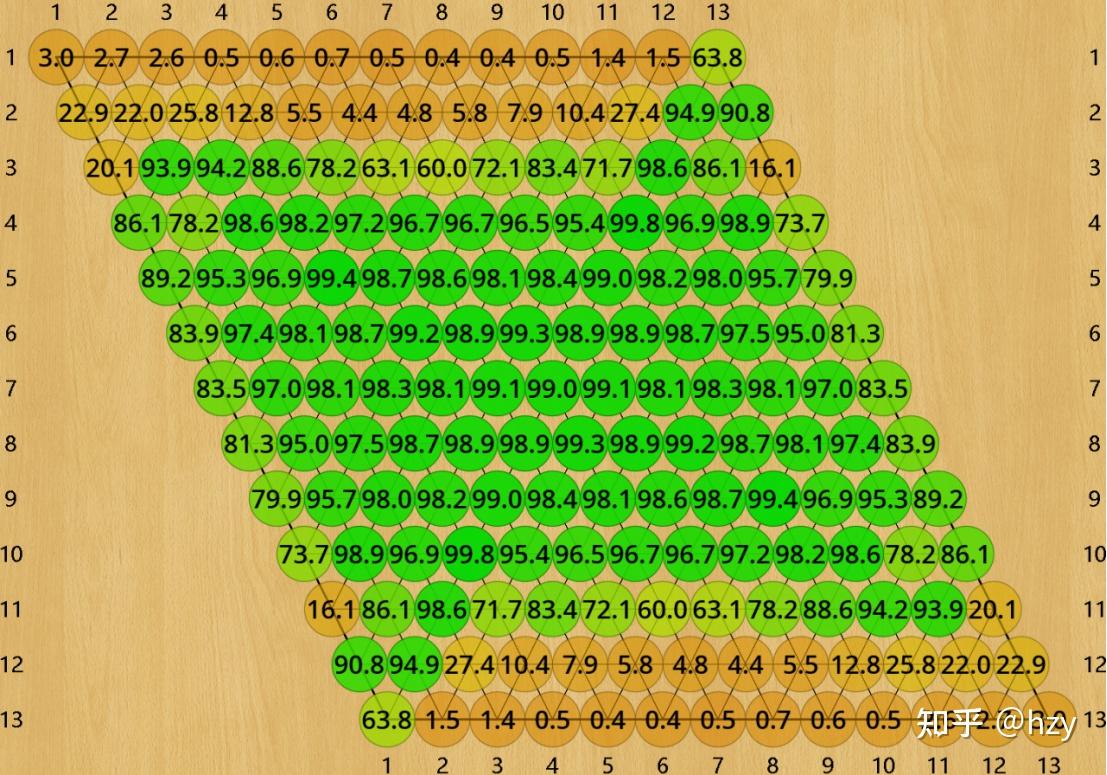
- Swap map for 19×19 generated with net 20220618, with around 15k visits for most moves. For the red hexes, the number corresponds to Blue's Elo advantage if she swaps Red's move; for the blue hexes, the number corresponds to Blue's Elo advantage if she does not swap Red's move. Smaller numbers correspond to fairer openings. Includes all fair openings as well as a few selected unfair openings, including the strongest move without swap (e10). I used more visits for the fairest moves: 1000k for e3 (49.5% win rate), 500k for n3 (49.2%), 100k for a15 (52.5%).
Random unsolved questions
Most of these are very difficult to answer, and I would be happy if even a few were answered in the next few years:
- Is the obtuse corner always winning on larger board sizes? What about the b4 opening? Let P(n) be the statement that "the obtuse corner is a winning opening in n×n Hex without swap." There are a few possible cases; an interesting exercise is to come up with subjective probabilities of each case being true.
- A. P(n) is always true. If so, can we prove this?
- B. P(n) is true for infinitely many n, with finitely many counterexamples. If so, what's the smallest counterexample?
- C. P(n) is true for infinitely many n, with infinitely many counterexamples. If so, does P(n) hold "almost always," "almost never," or somewhere in between?
- D. P(n) is true for finitely many n. If so, what's the largest such n?
- Kriegspiel Hex (Dark Hex), a variant with incomplete information
- Under optimal mixed strategies, what is Red's win probability on 4×4?
- For larger boards (say, 19×19), is Red's win probability close to 50%?
- If so, a swap rule might not be needed for Kriegspiel Hex, which would be neat.
- If not, imagine a variant where Red's first move is publicly announced to both players, and Blue has the option to swap it. Which initial moves are the fairest now?
replies by Demer:
- https://zhuanlan.zhihu.com/p/476464087 has percentages, although it doesn't translate these into a guessed swap map and I don't know anything about the bot they came from.
- It suggests that [on 13x13, g3 is the most balanced opening] and [on 14x14, g3 should not be swapped].
- On 27x27 without swap, it likes the 4-4 obtuse corner opening slightly more than anything else nearby.
- As far as I'm aware, even 3×4 Dark Hex has not been solved. (https://content.iospress.com/articles/icga-journal/icg180057 apparently gives "some preliminary results" for that size.)
hexanna:
- Thank you, this is amazing! From the Google Translate, the bot is an adaptation of KataGo trained on 13×13 and smaller, using transfer learning to train larger nets on top of the 13×13 net for a short period of time. I may edit the swap rule article later with some insights.
- The results for up to 15×15 look very reliable to me. This is because many of the subtle patterns suggested by other bots, like leela_bot, appear in these swap maps. For example, on 13×13:
- a1–c1 are stronger than d1; a2–c2 ≥ d2 ≥ e2 in strength; and a similar relation holds for moves on the third row. See Openings on 11 x 11#d2.
- b4 is weaker than all of its neighbors, because Blue can fit the ziggurat in the corner.
- j3 is surprisingly weak and i3 is surprisingly strong. Many people were surprised about this when leela_bot's swap map came out, but the result may be more than just random noise.
- a10 is the weakest of a4–a10, while a5 is the strongest.
- b10 is stronger than all of its neighbors, because Blue cannot fit the ziggurat in the obtuse corner.
- That this bot picked up on all these subtleties, and assigns a win percentage close to 100% for most moves on 13×13, suggest to me that it is probably stronger than leela_bot and gzero_bot. I can't know for sure, though.
- On the other hand, and the author seems to agree, the 37×37 map looks very unreliable. I see percentages as low as 37% but only as high as 54% (for a move like f1, which should almost certainly be a losing move).
- The 27×27 map looks more reliable. I'm personally very skeptical that moves on Red's 6th row are among the most balanced moves, but there are some interesting (if somewhat noisy) insights to be had still.
- The results for up to 15×15 look very reliable to me. This is because many of the subtle patterns suggested by other bots, like leela_bot, appear in these swap maps. For example, on 13×13:
Recursive swap
Not really a serious suggestion, just for fun. One advantage of "recursive swap" over multi-stone swap is that opening preparation plays a smaller role, because both players have control over the first n stones.
RECURSIVE_SWAP'[k, depth, color]:
  if depth = 0:
    [color] continues playing as normal.
  else:
    [color] plays a move. [~color] can either
      swap[k], or
      RECURSIVE_SWAP'[k+1, depth-1, ~color]

RECURSIVE_SWAP[n]:
  RECURSIVE_SWAP'[1, n, Red]
RECURSIVE_SWAP[0]:
Red continues playing as normal.
RECURSIVE_SWAP[1]:
Red plays a move. Blue can either
- swap, or
- continue playing as normal.
RECURSIVE_SWAP[2]:
Red plays a move. Blue can either
- swap, or
- play a move, after which Red can either
- swap2, or
- continue playing as normal.
RECURSIVE_SWAP[3]:
Red plays a move. Blue can either
- swap, or
- play a move, after which Red can either
- swap2, or
- play a move, after which Blue can either
- swap3, or
- continue playing as normal.
Analysis
RECURSIVE_SWAP[0] is the same as playing with no swap.
RECURSIVE_SWAP[1] is the same as playing with the swap rule.
RECURSIVE_SWAP[2]:
- Red shouldn't play a move that's too strong or it'll be swapped.
- If Red plays a weak stone, Blue should try to play a move just strong enough that Red will be indifferent to swap2. (If a "fair" move is half a stone, and Red plays a weak move worth x < 0.5 stones, Blue should play a move worth x + 0.5 stones.)
- Red should try to play a weak move that's also hard for Blue to equalize (so that Red gets a sizable advantage when deciding whether to swap2 or not).
RECURSIVE_SWAP[3]:
- If Red plays a move worth x > 0.5 stones, Blue should swap.
- If Red plays a weak stone worth x < 0.5, Blue should play a move worth less than x + 0.5 (or else Red will swap2). If Blue's move is worth y, then Red should play a move as close to (y - x) + 0.5 as possible, so that Blue's swap3 decision is difficult.
- Red should play a weak move that's hard for Blue to find a tricky reply to (where a "tricky" reply is one that makes it hard for Red to equalize, such that Blue has an easy time deciding whether to swap3 or not).